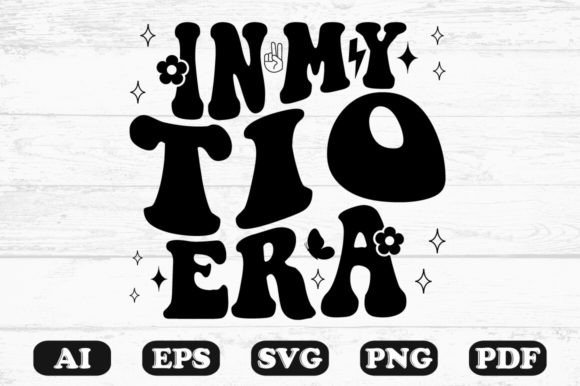
In My Tio Era Retro Wavy SVG T-shirt
First Impressions: A Nostalgic Whisper, Not a Shout
Opening In My Tio Era Retro Wavy SVG T-shirt feels like flipping through a well-loved 90s zine—warm, slightly imperfect, and full of personality. The wavy typography isn’t aggressively retro; it leans into soft curves, gentle undulations, and balanced negative space. There’s no heavy drop shadow, no chrome effect, no forced “vintage” grit. Instead, it carries quiet confidence—like a handwritten note passed in homeroom, not a billboard. As an embroidery designer who’s stitched everything from nursery onesies to boutique aprons, I immediately saw its potential for handmade products that feel personal, not mass-produced.
Where It Lives Best: Real Projects, Real Fabric
Last week, I used In My Tio Era Retro Wavy SVG T-shirt to embroider a set of linen tea towels for a local kitchenware pop-up. The design scaled beautifully at 4.2" wide—large enough to read clearly, small enough to sit comfortably on the towel’s lower corner without overwhelming the fabric’s natural texture. It worked just as well on a heavyweight cotton sweatshirt (using medium cutaway stabilizer) and on a lightweight canvas tote bag (with tear-away + light iron-on). The wavy baseline actually helped disguise minor tension inconsistencies—something I’ve learned to appreciate when stitching across seams or curved hems.
This isn’t a design built for high-detail appliqué or dense fill-stitch backgrounds. It’s a text-driven embroidery file, clean and confident in its simplicity. That makes it ideal for: custom apparel with emotional resonance (think birthday gifts for uncles, graduation tees for cousins), baby embroidery where clarity matters more than complexity, embroidered patches for denim jackets, and small shop merchandise where brand voice is warm and approachable—not corporate or overly polished.
Where to Pause—and Test First
Don’t assume In My Tio Era Retro Wavy SVG T-shirt will translate flawlessly onto every surface. On stretchy fabrics like ribbed knits or thin jersey t-shirts, the wave shape can distort if hooping isn’t precise or stabilizer isn’t layered correctly. I recommend testing on scrap fabric *before* stitching a finished product—especially for sweatshirt embroidery or baby embroidery, where fit and comfort are non-negotiable.
It also needs breathing room. On curved surfaces like caps or curved pillow covers, the outer edges of the wave may pull or pucker if digitized without contour compensation (which this SVG-based file likely doesn’t include unless professionally converted). And while the letterforms are legible at 3", they start to lose definition below 2.5"—so skip it for tiny hat brims or delicate baby onesie pockets unless you’re willing to simplify manually.
- Dark fabric? Use bright, contrasting thread—cream or mustard works better than white on charcoal.
- Textured fabric? Linen, burlap, or terry cloth benefit from a light topping stabilizer to smooth the surface before satin stitch runs.
- Frequent washing? Reinforce with a running stitch outline or slight underlay—this design’s open layout means fill stitches aren’t densely packed, so extra security helps longevity.
What It Adds to Your Handmade Product—Beyond the Stitch
Customers don’t just buy embroidered text—they buy feeling. In My Tio Era Retro Wavy SVG T-shirt lands somewhere between playful and sincere. It doesn’t scream “trendy”—it whispers “I remember.” That builds trust. When I listed the tea towels online, buyers commented on how “genuine” and “unforced” the phrase felt—no irony, no detachment. That authenticity lifts perceived value, especially for personalized gifts and boutique branding.
For Etsy sellers and craft fair vendors, it’s a smart design asset: versatile enough for multiple product types (tote bag design, apron embroidery, holiday embroidery), yet distinctive enough to stand out in a sea of generic quotes. It pairs naturally with minimalist mockups—no need for busy backgrounds. And because it’s rooted in typography rather than illustration, it scales cleanly across digital embroidery files, printable mockups, and even simple heat-transfer prep.
Practical Notes Every Embroidery Designer Should Check
Before using In My Tio Era Retro Wavy SVG T-shirt in your next project—or listing it as part of a commercial embroidery bundle—take five minutes to verify:
- Test on scrap fabric first, especially with your go-to stabilizer combo.
- Check thread color contrast on both light and dark fabric swatches—what reads well on white may vanish on navy.
- Review stitch density: Is it optimized for standard machine embroidery? Or does it lean toward cutting files or screen-print prep? (SVG files often need digitizing for true embroidery use.)
- Confirm hoop size compatibility. Does it fit comfortably in your most-used hoop—or will you need to split it?
- Inspect small details: Are serifs or wave endpoints crisp at your intended size? Zoom in—what looks fine on screen may fray or blur when stitched.
- Try black-and-white mockups to assess visual weight and rhythm without color distraction.
- Verify licensing: Is this SVG file cleared for commercial embroidery, resale of finished products, or digital product bundles? Never assume—check the seller’s terms.
A Design That Earns Its Place
In My Tio Era Retro Wavy SVG T-shirt won’t replace your workhorse monogram or intricate floral motif—but it fills a quiet, valuable gap in your design assets. It’s the kind of embroidery file that makes a baby gift feel like a family heirloom, turns a plain tote into a conversation starter, and gives a small shop product instant warmth and intention. In a market flooded with loud, algorithm-friendly graphics, this one earns attention by being thoughtful, adaptable, and human-scaled.
Use it where authenticity matters more than flash. Stitch it where people pause, smile, and say, “Yeah—I get that.” That’s not just good design. That’s good craft business.