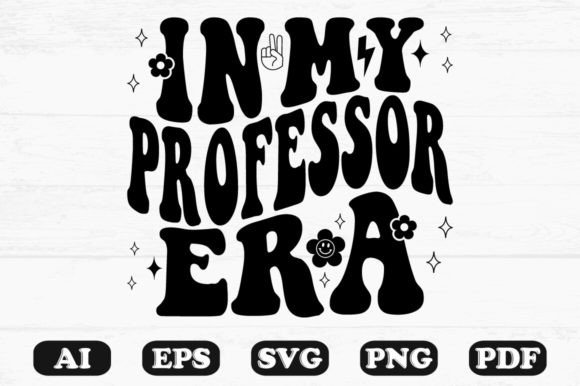
In My Professor Era Retro Wavy
First Impressions: A Nostalgic Whisper, Not a Shout
When In My Professor Era Retro Wavy landed in my inbox, I paused—not because it’s flashy, but because it’s quietly confident. It’s not shouting “vintage!” with loud distressed textures or chaotic layout. Instead, it leans into clean, rhythmic undulation: soft curves in the letterforms, subtle weight shifts, and a relaxed rhythm that feels like chalk on a university blackboard crossed with a 70s campus poster. As an embroidery designer who’s stitched hundreds of text-based designs, I immediately asked: Will this hold up under needle and thread—or collapse into mush?
A Real-World Test: Embroidering a Linen Tote for a Local Bookstore
Last week, I used In My Professor Era Retro Wavy to embroider a medium-weight natural linen tote for a neighborhood indie bookstore’s staff gift program. The goal? A design that felt thoughtful, approachable, and subtly academic—no tweed clichés, no horn-rimmed glasses doodles. Just warmth, wit, and wearability. I chose a matte cotton thread in deep charcoal on off-white linen, stabilized with medium tear-away + light cutaway backing. The result? Crisp curves, even spacing, and zero distortion—even where the wavy baseline dips slightly below the cap height. That tells me the vector construction is intentional, not accidental.
Where It Shines (and Where It Asks for Help)
In My Professor Era Retro Wavy excels in contexts where personality matters more than precision: custom sweatshirt embroidery for grad students, embroidered patches for library volunteer programs, pillow covers for faculty lounges, or tea towels for university alumni shops. Its gentle wave adds movement without visual noise—ideal for apparel decorators balancing readability and charm.
But here’s what I’d tell any craft business owner before pressing “embroider”: this design assumes a minimum hoop size of 4x4 inches. On a curved surface like a baseball cap front, the outermost curves may stretch or compress unless digitized with careful underlay and reduced density. And while it reads beautifully on medium-to-heavy fabrics—cotton twill, fleece, canvas—it’ll struggle on thin baby knit or highly stretchy jersey without significant stabilizer adjustment and possibly manual repositioning.
Stitching Clarity & Customer Trust Go Hand in Hand
Embroidery isn’t just decoration—it’s a signal of care. When customers see In My Professor Era Retro Wavy stitched cleanly on a handmade apron or boutique sweatshirt, they don’t just read the phrase—they register intentionality. The evenness of the wavy baseline suggests technical control, which subconsciously boosts perceived value. That matters doubly for Etsy sellers and small shop owners: a well-executed In My Professor Era Retro Wavy says “I know my craft,” not “I slapped on a trendy SVG.”
Practical Designer Notes You Can’t Skip
- Always test first—on scrap fabric matching your final project’s weight and texture. Linen behaves differently than cotton poplin; fleece hides stitch gaps that show starkly on chambray.
- Check contrast early. This design relies on shape, not bold outlines. On dark fabric, avoid light pastel threads—go for tonal depth (e.g., charcoal on navy) or high-contrast matte black.
- Review stitch density. If your embroidery file includes fill-stitch elements (like shadow layers or background shapes), confirm they’re optimized for breathable fabrics. Overly dense fills trap heat and stiffen garments—bad for baby embroidery or holiday gifts meant for daily use.
- Hoop size isn’t optional. If you’re using this for commercial embroidery on crewnecks or tote bags, verify the design fits your standard hoops *before* batching orders. Resizing wavy typography risks flattening the very feature that gives In My Professor Era Retro Wavy its voice.
- Inspect corners and transitions. Zoom in digitally: do the curves taper cleanly? Are there tiny anchor points where satin stitch might pucker? These details make or break a polished finished product.
- Mock it both ways: generate printable mockups on light and dark backgrounds. What reads as playful on ivory can feel washed out on oatmeal. Also try a black-and-white version—this design’s strength is in silhouette, not color.
- Confirm licensing. Since In My Professor Era Retro Wavy is listed as a Graphics product in the Crafts category, double-check whether the bundle permits commercial use of finished embroidered items—and whether resale of the digital embroidery file itself is allowed. When in doubt, contact the creator.
Beyond the Stitch: Branding, Gifting, and Quiet Confidence
I’ve seen In My Professor Era Retro Wavy used brilliantly on nursery decor—tiny embroidered onesies paired with minimalist bookshelf labels—and awkwardly on ultra-slim phone cases where the wave got lost in scale. Its sweet spot is human-scale, tactile products: embroidered patches sewn onto denim jackets, custom aprons for coffee shops with academic ties, or personalized graduation gifts where “professor era” lands as aspirational, not ironic.
For creative entrepreneurs, this isn’t just another typography SVG. It’s a tone-setter. Used thoughtfully, it elevates a handmade product from “cute” to “considered.” It invites conversation—not because it’s loud, but because it’s specific, warm, and quietly self-aware. That kind of resonance builds repeat buyers, word-of-mouth referrals, and Instagram tags that feel earned, not engineered.
Final Thought: Design With Purpose, Not Just Pixels
In My Professor Era Retro Wavy won’t solve every embroidery challenge—but it solves a very real one: how to communicate intelligence, warmth, and individuality through a single line of text. It’s not for every project. But for the right tote bag, the right sweatshirt, the right gift for someone stepping into their next chapter? It’s exactly the kind of design that makes people pause, smile, and say, “Yes—that’s *me*.” And in craft business, that moment of recognition is worth more than any trend.