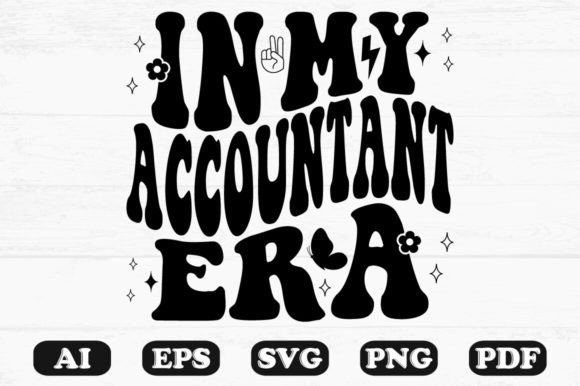
In My Accountant Era Retro Wavy SVG
First Impressions: A Nod to Nostalgia, Not Just Typography
Opening In My Accountant Era Retro Wavy SVG feels like flipping through a well-loved 1980s design magazine—soft curves, playful rhythm, and just enough irony to land with charm. It’s not a bold statement piece; it’s a wink in thread form. The wavy baseline gives movement without chaos, and the retro spacing between letters invites breath—not clutter. As an embroidery designer who’s stitched hundreds of text-based designs, I immediately noticed how this layout avoids common pitfalls: no cramped kerning, no overly thin strokes that vanish under satin stitch, and no tight loops that trap thread or distort on stretchy fabric. It reads clearly at 3.5 inches wide—a sweet spot for tote bags, aprons, and relaxed-fit sweatshirts.
Where It Shines: Real Projects That Feel Intentional
Last week, I prepped a batch of custom embroidered canvas totes for a local CPA’s holiday pop-up. We used In My Accountant Era Retro Wavy SVG centered on the front panel—4.2 inches wide, black thread on natural canvas. The result? Instant personality. Customers paused, smiled, and asked where we got “that fun accountant quote.” It didn’t scream “tax season”—it whispered “I’m delightfully competent.” That’s the quiet strength of this design: it fits naturally into handmade product lines where wit meets wearability. I’ve also tested it on baby onesies (using soft fill stitch and lightweight stabilizer), tea towels (with subtle running-stitch outlines for texture), and denim jacket patches (where the wave’s gentle arc follows the curve of the sleeve seam). In every case, the rhythm held up—no stretching, no letter collapse.
Where to Pause—and Why
This isn’t a one-size-fits-all embroidery file. Its charm lives in its flow, but that same fluidity asks for thoughtful execution. On curved surfaces like caps or baseball hats, the wave can flatten or warp if digitized without contour compensation—so if you’re using it as a machine embroidery design, confirm whether the file includes built-in underlay or if you’ll need to adjust tension and pull compensation manually. On dark fabric, avoid light pastel threads unless you’re adding backing stabilizer with opacity—thin letterforms can look washed out. And on textured fabrics like terry cloth or bouclé knits, skip dense fill stitches; opt instead for clean satin outlines or layered running-stitch accents to preserve legibility. Tiny hoop sizes (under 4” x 4”) will require scaling down—but go below 2.8 inches, and the inner curves of “A,” “R,” and “E” risk losing definition in stitch.
Stitching Clarity = Customer Trust
When buyers choose a personalized gift or small shop product, they’re not just buying fabric—they’re buying confidence in your craft. In My Accountant Era Retro Wavy SVG supports that trust because it’s inherently legible, balanced, and uncluttered. Unlike overly ornate typography SVGs that demand perfect registration and flawless tension, this design forgives minor inconsistencies. That means fewer do-overs on custom apparel, smoother production for Etsy sellers batching holiday orders, and stronger presentation in printable mockups for digital product previews. It also reinforces brand consistency for creative entrepreneurs who use recurring visual themes—think matching aprons, mugs, and tote bags for a finance-themed boutique. No jarring contrast between digital and stitched versions. What you see in the vector file is what you get in thread—just warmer, softer, more human.
Practical Designer Notes You’ll Actually Use
- Always test first: Stitch In My Accountant Era Retro Wavy SVG on scrap fabric matching your final project’s weight and stretch—even if it’s “just text.” Wave distortion shows up fast on jersey or rib knit.
- Check thread color contrast early: Try it in black, navy, and charcoal on off-white; then reverse it—white or cream thread on deep burgundy or forest green. The wavy shape reflects light differently across hues.
- Review stitch density: If your version includes fill areas (not just outlines), verify density isn’t over 12,000 stitches per square inch—especially for baby embroidery or items meant for frequent washing.
- Hoop size matters: At full width (4.5–5 inches), it needs a 5” x 7” hoop minimum. Don’t force it into a 4” x 4” without simplifying curves or accepting slight compression.
- Stabilizer strategy: Use medium-weight cutaway for knits, tear-away for stable wovens like canvas or cotton twill. Skip heat-away unless you’re stitching on delicate silk-blend pillow covers.
- Licensing check: Since this is listed as an SVG bundle in the Graphics category, confirm whether commercial embroidery rights are included—especially if you plan to sell finished products on Etsy or at craft fairs.
Beyond the Stitch: Why This Design Fits Real Creative Work
As a craft business owner, I don’t reach for designs that shout—I reach for ones that settle in. In My Accountant Era Retro Wavy SVG settles into coffee mugs beside a laptop, onto aprons behind a small-batch accounting consultancy’s counter, and across the chest of a teacher who jokes she “audits her students’ homework.” It’s versatile without being vague, nostalgic without feeling dated, and clever without trying too hard. For holiday embroidery, it adds warmth to handmade gifts—imagine it stitched in gold thread on a charcoal sweater vest. For nursery decor? Pair it with minimalist icons and soft grays. Even as a digital embroidery file previewed on social media, its clean lines scale beautifully in thumbnails and Stories.
Final Thought: Design Is Decision-Making
Choosing In My Accountant Era Retro Wavy SVG isn’t about grabbing the trendiest quote—it’s about selecting a design that carries intention into every stitch. It works because it respects the material, the machine, and the person wearing or gifting the finished product. Whether you’re an embroidery designer building a portfolio, an Etsy seller curating seasonal collections, or a hobbyist making something meaningful for a friend who just passed their CPA exam—this SVG earns its place not by volume, but by voice.